In 1836, Thomas Cole (1801-1848) painted View from Mount Holyoke, Northampton, Massachusetts, after a Thunderstorm—The Oxbow, now in the collection of the Metropolitan Museum of Art in New York. The Met notes, “Cole juxtaposed stormy, untamed wilderness on the left with a sunlit, pastoral settlement on the right to emphasize the diverse possibilities of the American landscape. At the lower center the artist depicted himself, pausing from a sketch, gazing directly at the viewer.”
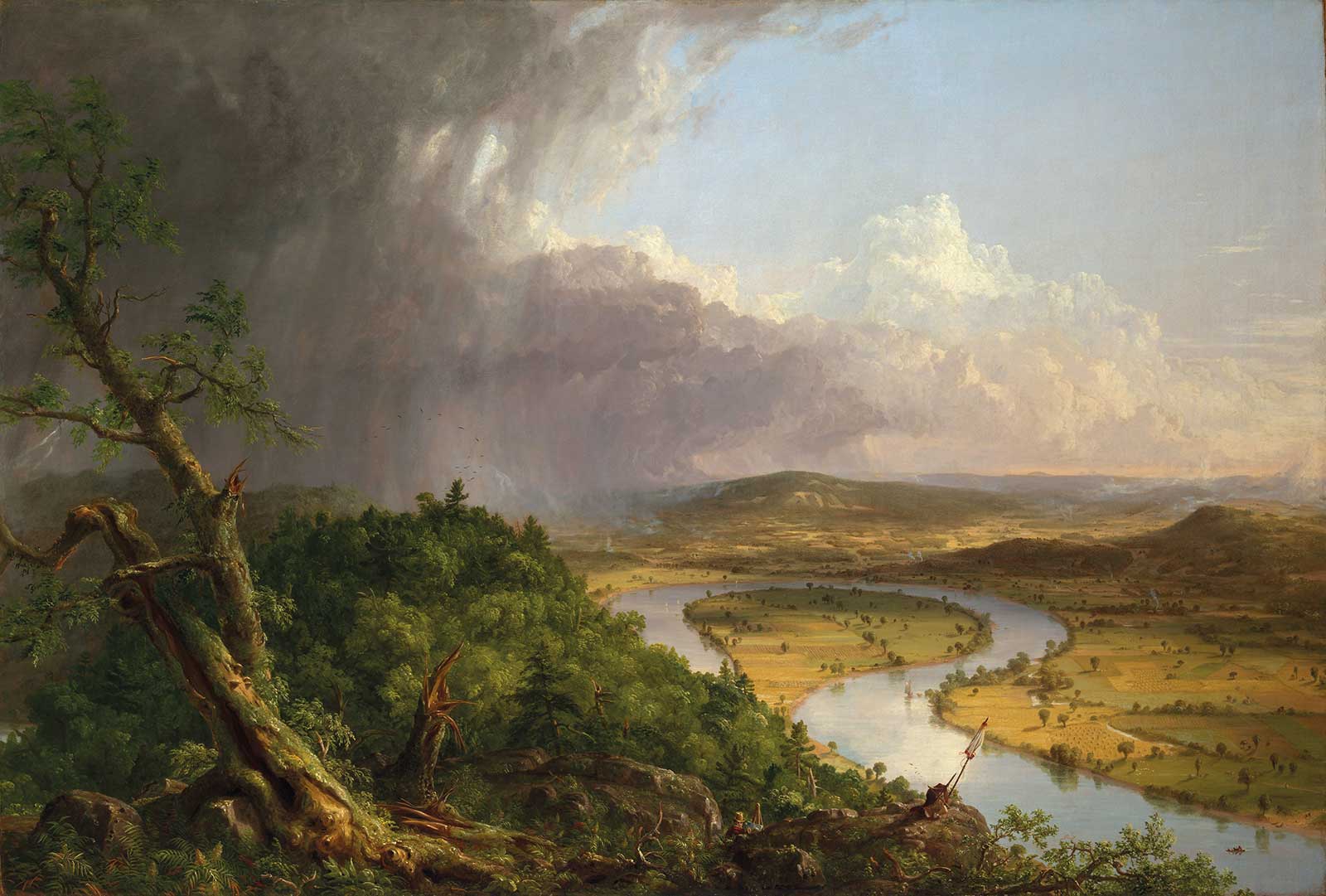
Thomas Cole (1801-1848), View from Mount Holyoke, Northampton, Massachusetts, after a Thunderstorm—The Oxbow, 1836, oil on canvas, 51½ x 76 in. The Metropolitan Museum of Art, New York, NY. Gift of Mrs. Russell Sage, 1908.
Cole’s self-portrait draws the viewer in, perhaps commenting on the fact that he is recording or interpreting the scene before him. His interpretation is referred to in contradictory ways by critics—an endorsement of Manifest Destiny in which the country was divinely ordained to expand West, and the regret that the divine presence in the wild landscape was being encroached upon by expansion. Cole wrote, “I cannot but express my sorrow that the beauty of such landscapes are quickly passing away. The ravages of the axe are daily increasing. The most noble scenes are made desolate, and oftentimes with a wantonness and barbarism scarcely credible in a civilized nation. This is a regret rather than a complaint. Such is the road society has to travel.”
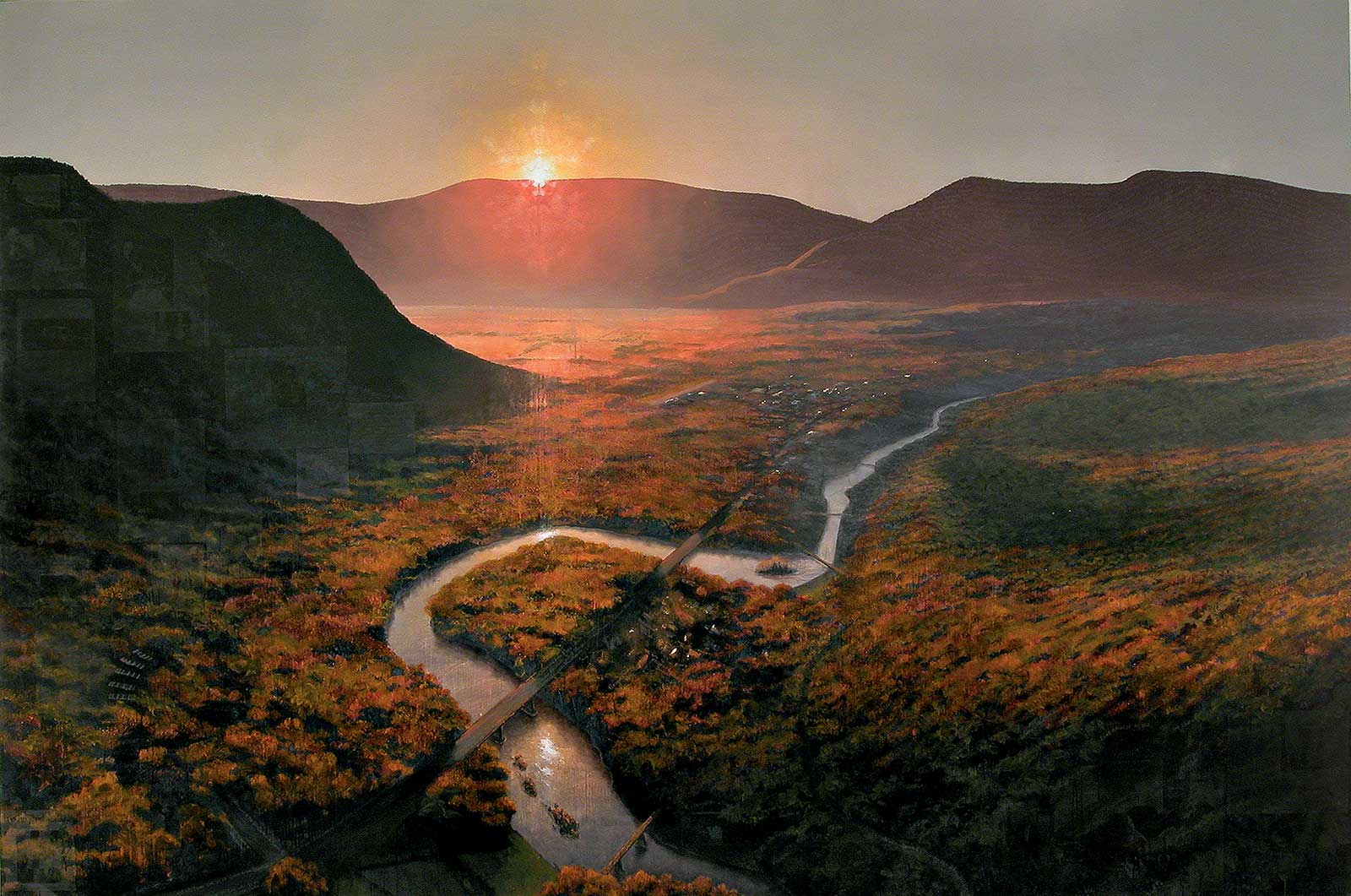
Stephen Hannock, A Recent History of Art in Western Massachusetts; Flooded River for Lane Faison (Mass MoCA #10), 2005, polished oil on canvas, 96 x 144 in. National Gallery of Art, Washington, D.C.
Stephen Hannock lived near the Oxbow, the U-shaped bend in the Connecticut River, for 17 years and painted over 40 images of the scene, one of which joins Cole’s painting at The Met. Cole’s Oxbow painting refers visually to the scene and to the philosophies forming America and American art. Hannock’s Oxbow paintings evoke a mood and contain text, collaged images and references to his personal history and relationships. A favorite quote of mine is the epigraph of E.M. Forster’s novel Howards End, “Only connect.” Hannock’s broad connections enrich his life and animate his paintings. Our own connection began without our knowing it when, in 1971, I was working at Bowdoin College in Maine and Hannock played on the hockey team. As “officers of administration” we were obliged to attend the hockey games and I watched him play.
As we recently reminisced about other parallels and ships passing in the night events, I mentioned that in 1960 I had studied music at Tanglewood, the summer home of the Boston Symphony, not far from where he now lives in the Berkshires of western Massachusetts. He asked, “Was Seiji there?” His late friend Seiji Ozawa, the internationally acclaimed conductor, was 25 at the time and I, at 16, had my own car and gave him rides from the Tanglewood music shed into town.
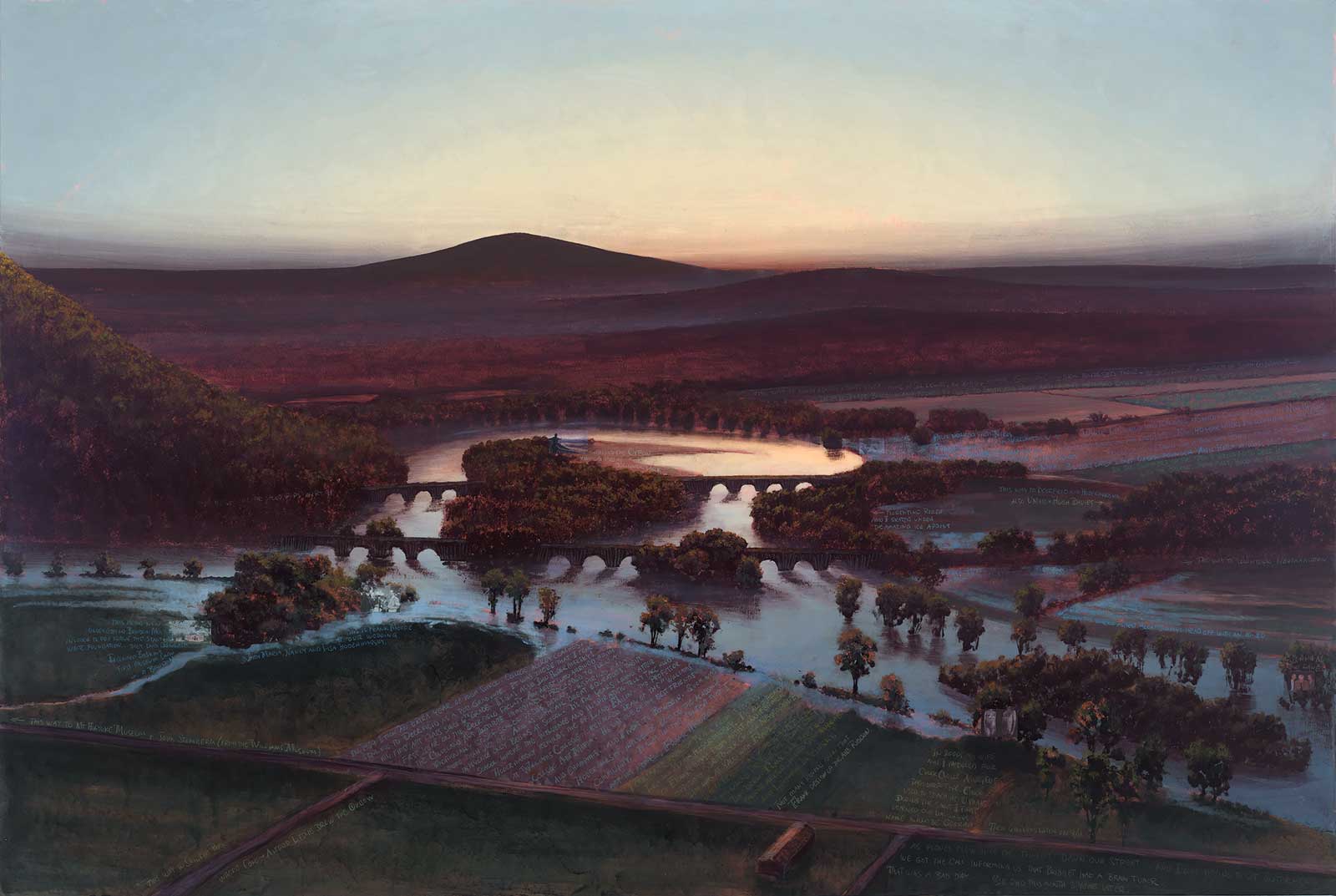
Stephen Hannock, Oxbow Flooded for Frank Moore and Dan Hodermarsky (Mass MoCA #196), 2013, polished oil on canvas, 48 x 72 in. Yale University Art Gallery, New Haven, CT.
Hannock had begun playing hockey in the fourth grade. His father had been captain of the team at Williams College and played semi-pro. He comments, “In athletics you learn very quickly a team dynamic that can take you to places you can’t imagine on your own.”
Hannock went to three different high schools to play hockey and a post-graduate year at Deerfield Academy where he was guided by the painter and art teacher Daniel Hodermarsky to whom he has dedicated several of his mature paintings. Hodermarsky recognized his lack of interest in academics and told him, “Just go out and draw!” He was waitlisted at Bowdoin and recounts, “Dick Moll, the director of admissions, saw my watercolors and said ‘These are good!’ and I got in after another hockey goalie decided to go to Harvard.”
Unlike the stories of Lemony Snicket, Hannock’s life has been a series of fortunate events. In his sophomore year at Bowdoin, he took part in an exchange program at Smith College in Northampton, Massachusetts. There, Leonard Baskin, the sculptor, graphic artist and founder of the Gehenna Press, saw his paintings and invited him to work with him privately. Hannock cut the woodblocks that Baskin had drawn for a series of woodcuts on the works of Shakespeare, later published by Gehenna Press.
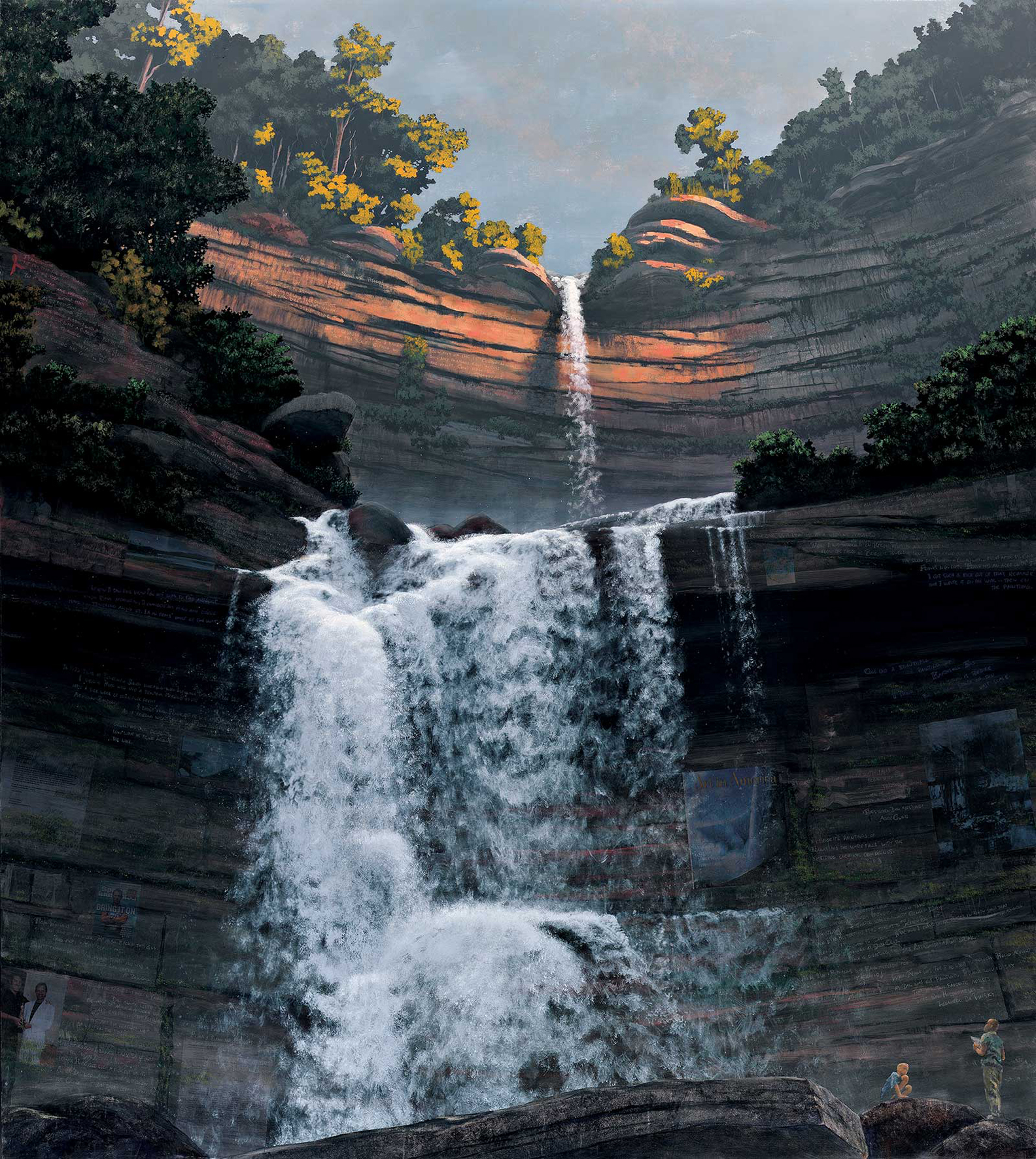
Stephen Hannock, Kaaterskill Falls for Frank Moore and Dan Hodermarksy (Mass MoCA #11), 2005, polished oil on canvas, 108 x 96 in. The Metropolitan Museum of Art, New York, NY.
When he was attending seminars at Smith he connected with Elizabeth Mongan, who taught art history there, and her sister, Agnes Mongan, who was director of the Fogg Art Museum at Harvard. Their connection and friendship continued for 25 years. His Oxbow painting at The Met is dedicated to them.
While working for Baskin he knew “I wanted to do my own stuff.” He began experimenting with phosphorescent paints creating large-scale, imaginary landscapes that glow when placed under black light. The jazz pianist Anthony Davis, who, in 2020, would receive the Pulitzer Prize for his opera The Central Park Five, played piano at exhibitions of Hannock’s paintings in the early ’80s. Forty-five years later, the two are revisiting their collaboration at Mass MoCA in North Adams, Massachusetts, in 2026.
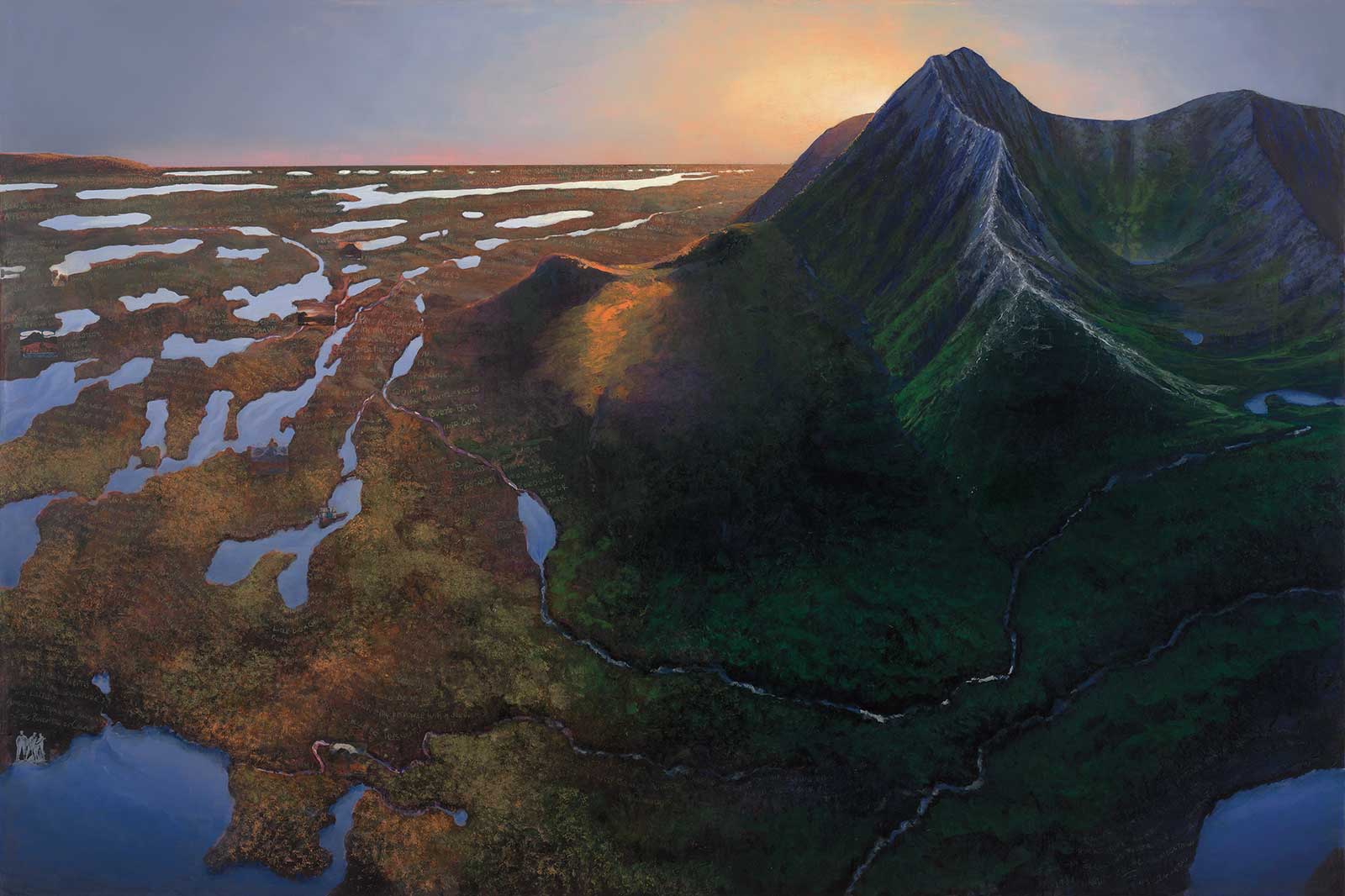
Stephen Hannock, Luminous Lakes below the Knife Edge (Mass MoCA #319), 2020, polished oil on canvas, 48 x 72 in. Farnsworth Art Museum, Rockland, ME.
Along with the fortunate events in his life, there have been happy accidents as he created his work. Gregory Gillespie advised him to use a power sander to remove a sky that had gone wrong—starting another canvas was too expensive. When he was done sanding, he found a surface that had a subtle luminosity. He refined his sanding technique to enhance the light in his paintings. When he was mopping up excess paint with old envelopes, he tossed one at the wastebasket and missed. “I found that what was on the floor was more interesting than the painting I was working on,” he laughs. “It was an envelope from a travel company that had been sent to me and I could still see the printed travel fee.” He began adding these bits along with his texts and other collaged images to make up the complex idiosyncratic associations that are part of the finished image.
In 1973, I was hired by two members of the “Williams Art Mafia,” Bob Buck and Jim Wood, to head the departments of publications and public relations at the Albright-Knox Art Gallery in Buffalo, New York. Bob would go on to be a director at Marlborough, Hannock’s gallery, and then director of the Brooklyn Museum. Jim later became director of the Art Institute of Chicago. The mafia were alumni of Williams from the 1960s and ’70s who were influenced by the college’s stellar art history faculty, notably S. Lane Faison, Jr. They, like the Hudson River School painters, were not an organized group but were people of like mind. Ironically, Faison taught Hannock’s father at Williams.
One of Hannock’s paintings in the collection of the National Gallery of Art is A Recent History of Art in Western Massachusetts; Flooded River for Lane Faison (Mass MoCA #10),2005. Faison, his “dear friend,” also wrote the preface to the book, Luminosity: The Paintings of Stephen Hannock.
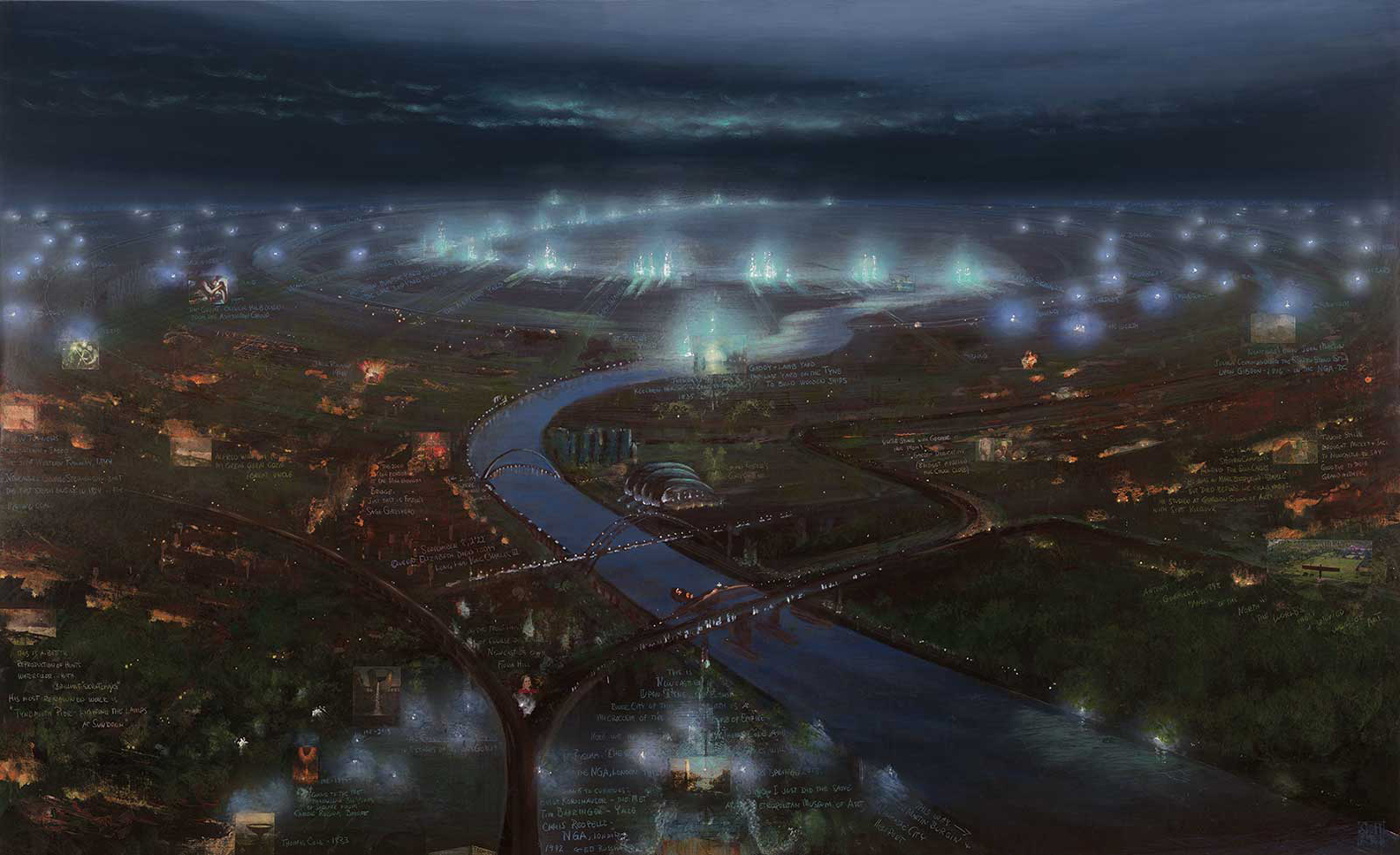
Stephen Hannock, Course of Empire, The River Tyne (Mass MoCA #291), 2018-2025, polished mixed media on canvas, 44 x 72 in.
In 2017, Hannock donated his painting The Great Falls; for Xu Bing (MassMoca #180), 2013 to the then Albright-Knox Art Gallery. Greatly expanded, it is now the Buffalo AKG Art Museum. The museum explains, “Although this painting appeals to the long-standing relationship between artists and Niagara Falls, Hannock aims to reclaim this history and draw new perceptions from the environment. He explains, ‘To render the great falls of Niagara has been a tradition among painters for generations. Then, to appreciate a celebrated vista anew is always the challenge. I’ve ‘set the stage’ for my stories (written throughout the composition) from a perspective below the falls…looking up to the towering volume of falling water.’ Here, Hannock incorporated reproductions of works by artists such as Frederic Edwin Church, Thomas Cole, Frank Moore, and Cindy Sherman that came to mind when he considered the myths and oral histories around the natural wonder. Inscriptions on the cliffs, which are based on a sequence of thoughts that evolved from the artist’s research and experiences, function as a visual diary. Each of these components dissolves into the rhythmic expanse of the work—only to be discovered by the attentive viewer.”
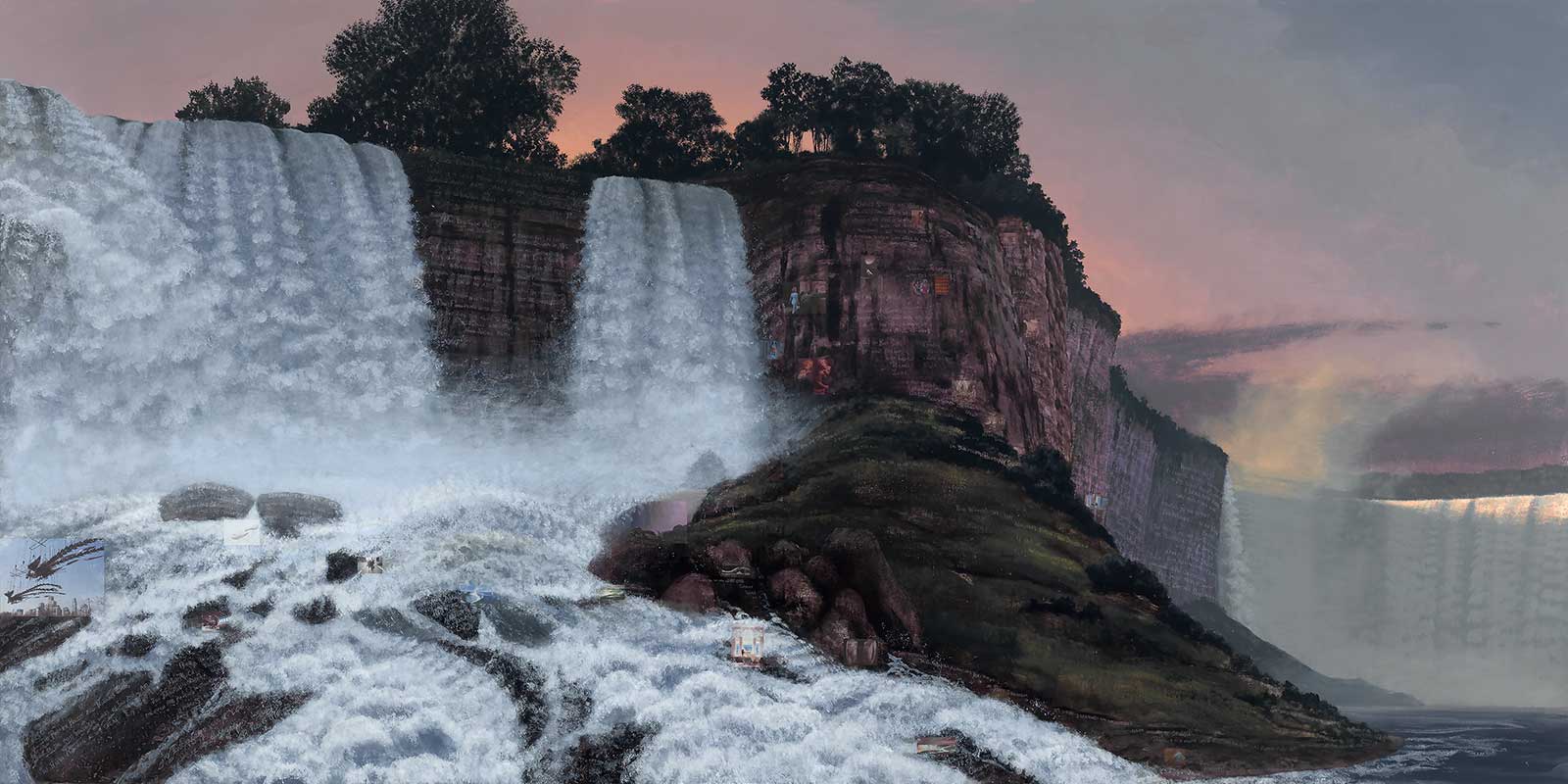
Stephen Hannock, Great Falls at Dawn for Xu Bing (Mass MoCA # 180), 2013 polished mixed media on canvas, 72 x 144” Buffalo AKG Art Museum, Buffalo, NY.
Hannock says, “I have a very tough time working from photographs. They squash down the rhythms I’m looking for.” Preparing for The Great Falls, the American Falls of Niagara, he fabricated a waterproof sketch book and hired a tugboat to take him right up to the rocks beneath the falls.
“The attentive viewer” finds that the limestone strata of the Niagara escarpment, over which the Falls fall, are composed primarily of Hannock’s texts, his story on millions of years of geologic history.
At 74, Hannock looks to a future based on continuous discovery. “With every piece, I’ve discovered a procedure that allows me to go on and that changes in the next piece,” he says. “What stays the same is that during the process of bringing an idea to life, you have to pick a moment to see what the paint has done. Paint is accident prone, and I like having my marks be unpredictable.”
The light emanating from Hannock’s paintings enlightens our observation and his inclusions obliterate the “weird Americana vibe” he knows can kill the life of a painting. They cause us to look differently at the landscape and experience, vicariously, the rich, diverse experiences of the artist.
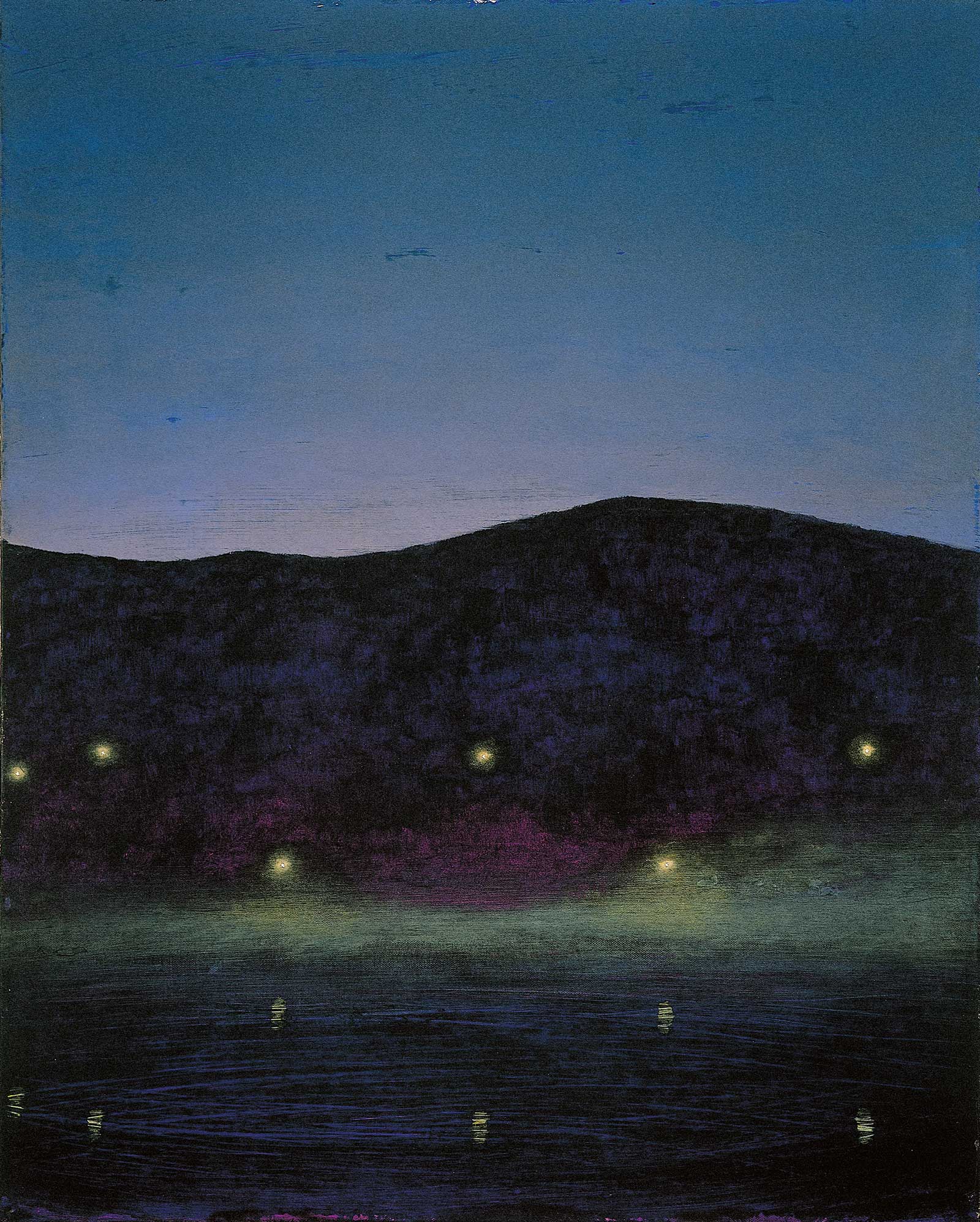
Stephen Hannock, Homage to the River Keeper, 1993, polished oil on canvas, 30 x 24 in. Bowdoin College Museum of Art, Brunswick, ME.
Hannock’s realism encourages moments of meditation on tonality, color and light—moments we can easily miss. Realism has survived all the brief non-objective “isms” of the 19th and 20th centuries. Jean Cocteau observed, “True realism consists in revealing the surprising things which habit keeps covered and prevents us from seeing.” —
Powered by Froala Editor